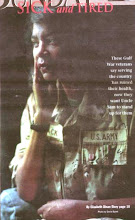
Post deployment illness Gulf War

The ground war lasted four days and resulted in 147 battlefield deaths, but almost 199,000 of the 698,000 people who were deployed have since qualified for some degree of service-related disability. Of those, 13,317 people are disabled by "undiagnosed conditions"; Medically Unexplained Symptoms; Medically Unexplained Physical Symptoms (MUPS) or Unexplained Symptoms

Tuesday, November 02, 2010

What piece of mind for Gulf War Veterans

Finally, piece of mind for Gulf War Veterans
by SENATOR JAY ROCKEFELLER

A long-anticipated report was recently and finally issued that
brought comfort to many Gulf War veterans and their families. The
report issued by the Congressionally-mandated Research Advisory Com-
mittee on Gulf War Veterans' Illnesses in conjunction with the
Boston University School of Public Health reached an important
conclusion ? simply put: there is substantial and overwhelming
evidence that Gulf War Syndrome is a real illness.

The Committee report is important news for Gulf War veterans and
their families. At long last, they have validation that the health
issues they live with each day are real, there is a name for their
illness, and there is hope that they can finally get the treatment
and disability benefits that they are entitled to receive.

Not long after the successful conclusion of the Gulf War, many
soldiers returned home with multiple, persistent health problems
that had no clear cause and no cure. The symptoms experienced by
these veterans included a combination of memory and concentration
problems, persistent headaches, unexplained fatigue and widespread
pain, and also included chronic digestive problems, respiratory
symptoms and skin rashes.

Unfortunately, Gulf War veterans' complaints about their health
issues fell on deaf ears at the VA and within the Pentagon. As
Chairman of the Senate Veterans Affairs Committee in the early
1990s, I believed it absolutely necessary to get to the truth ? no
matter how uncomfortable it would be for the Pentagon or the VA.

Throughout the 1990s, those of us on the Senate Committee on
Veterans' Affairs held numerous, often contentious, hearings into
what would come to be known as Gulf War Syndrome or Gulf War
Illness. The Pentagon and the VA never officially acknowledged the
cause of these symptoms. Despite the lack of an official cause, it
became clear through our investigation that pyridostigmine bromide,
a "pretreatment" for nerve agent poisoning, was at least one cause
for the symptoms experienced by Gulf War veterans.

Now, 17 years later, the Congressionally-mandated Research Advisory
Com-mittee on Gulf War Veterans' Illnesses has officially released a
450-page report that validates these suspicions. It confirms Gulf
War Illness is a result of soldiers' exposure to neurotoxic
chemicals, including pyridostigmine bromide and pesticides. The
Committee also found that the association between exposure to smoke
from oil well fires, neurotoxins, and the receipt of large numbers
of vaccines could not be ruled out as causes as well.

This report confirms the cause of Gulf War Illness, but sadly, it
also states that the majority of sick Gulf War veterans have not
seen their health improve over time. Treatment options for the
175,000 ? 210,000, or one in four, Gulf War veterans suffering from
the effects of neurotoxin exposure remain few and ineffective.

We have a moral responsibility to provide care for Gulf War
veterans. They served our country, put their lives on the line and
fought with great distinction. I will not stop fighting until our
veterans are provided with every resource and benefit they have
earned.

More research must be conducted into the proper treatment of this
illness. I am pushing now for increased funding that will keep this
issue front and center ? and bring us closer to finding a cure.

I have been working for Veterans my entire career. As a nation, we
owe them everything and can never forget how much they have
sacrificed and how deserving they are of piece of mind, support, and
a special thing called hope.
http:www.rockefeller.senate.gov/contact/

(PS) as lived by Venus Hammack a VA-DHA patient

Labels:

Sunday, August 29, 2010

Kamisiyah made some GW veterans Ill


WASHINGTON, Jan. 21— For the first time, a Federal agency acknowledged today that there appeared to be a direct link between the release of toxic chemicals in Iraq in 1991 and one of the many different symptoms that have come to be called gulf war syndrome.

A preliminary analysis by the Department of Veterans Affairs indicated that a limited sampling of soldiers exposed to low doses of nerve gas in the destruction of an Iraqi ammunition depot reported higher rates of arthritis-like joint symptoms than other soldiers who fought in the Persian Gulf war. But the findings are far from conclusive, said Federal researchers who have warned that the findings could change as more soldiers are examined.

''It's an interesting finding that raises questions,'' said Kenneth W. Kizer, the Under Secretary for Health Affairs at the veterans department, after announcing the results of the analysis at a House subcommittee hearing.

The study is based on the results of medical examinations of 1,978 veterans who were within 30 miles of the Kamisiyah ammunition storage area in southern Iraq when American troops destroyed the complex immediately after the gulf war in March 1991. Among the ammunition stored at the site were at least 500 rockets filled with sarin, a toxic nerve agent.

Of those 1,978 veterans, the 81 who were involved in blowing up the depot or were in the immediate area of the complex have not complained of suffering fatigue, skin rashes, headaches, loss of memory, chest pains or other symptoms at significantly higher rates than other American soldiers who fought in the gulf, according to the study.

But 28.4 percent of those 81 soldiers have reported various types of muscle and joint pains, compared with only 18.4 percent of the entire group of 1,978 veterans. A total of 16.8 percent of 52,216 gulf veterans so far examined by the Government have reported suffering the same arthritis-like symptoms.

The preliminary finding seems to run counter to one conclusion of a special White House panel, the Presidential Advisory Committee on Gulf War Veterans' Illnesses। The panel could find no evidence that exposure to chemical weapons had affected the health of gulf war veterans.

Until last June, Pentagon officials had denied for years that there was any evidence that American troops had been exposed to Iraqi chemical weapons at all. Now, they acknowledge that more than 20,000 troops might have been exposed to such agents during the destruction of the Kamisiyah depot, although there were no immediate reports of acute symptoms at the time. The 81 veterans most likely exposed to the poison gases included in the preliminary Veterans Affairs study represent only a small fraction of the 1,022 military personnel in the immediate vicinity of Kamisiyah.

Military and Veterans Affairs officials ultimately hope to interview all 21,799 military personnel who were within 30 miles of the storage site when it was destroyed. The records that so far have been included in the Veterans Affairs analysis are of veterans who have volunteered to be examined by the Government, often after complaining of suffering from one symptom or another.

''This health surveillance data is preliminary,'' Mr. Kizer told the House subcommittee, ''and is compiled from evaluations of a nonrandom, self-selected group of individuals possibly exposed to nerve agents at Kamisiyah.''

Jeffrey Ford, a 33-year-old gulf veteran who was a member of the 307th Engineering Battalion involved in the destruction of the depot, said he welcomed the Veterans Affairs analysis.

''It shows something in the area took place that affected these soldiers,'' Mr. Ford said. ''When you talk about joint pain, some of these people are in wheelchairs.''

Mr. Ford, who attended the hearing, said he had not had any symptoms attributed to the syndrome.

James J. Tuite 3d, director of the Gulf War Research Foundation, a group that calls on the Government to acknowledge that tens of thousands of veterans became sick from the war, said, 'After their repeated denials that there were any exposures whatsoever, the statement is certainly welcome.''

But Mr. Tuite added, ''What I am concerned about is the red herring of Kamisiyah. There were credible, scientific and reliable detections of chemical warfare agents in other locations, too.''

U.S. Agency Links Chemicals to One Illness of Gulf War Soldiers

Labels:

Monday, May 03, 2010

Good Advice for Gulf War Veteran

In all claims there are two parts. The first is the hardest, and that is proving that the veteran's illness is due to his or her service. The second part is determining to what degree the veteran is disabled, expressed by a percentage,
0 percent to 100 percent.

Here is my proposed RS (VA-ratings Staff) VBA checklist for GWI:

1.Was the veteran present in the theater of operations during the time frame established for the Persian Gulf War? Yes or No.

2.Does the veteran have an undiagnosed illness or one that is a medically unexplained chronic multi-symptom illness defined by a cluster of signs and symptoms or any diagnosed illness as outlined in VA regulations to a degree that warrants a presumption of service connection?
Yes or No.

3.If the RS marks Yes to both of these questions, then the veteran's disability is to be considered service-connected (SC) under Section 1117 - Undiagnosed Illnesses due to service in Southwest Asia. All that remains is a determination as to the percentage of disability.

The last part of my complaint about getting (gulf war veteran) GWV's their service-connected disability claims is the VA's outdated computer check-in system. A GWV may have four to six problems but is able to have only one listed for his or her check-in. When the RS looks over the veteran's file he/she does not see all of the problems that the veteran has because the VA's computer system cannot handle it. This will affect the claim in terms of the percentage of disability awarded.

The veteran must ensure that the examining physician (C&P) at the VA adds all complaints to the comment area. If the physician refuses to do so, the veteran should go to the VA's ER for the other problems. Also, have someone keep track of when you are ill and how bad it gets.
(Keep notes)

For some of us, mostly men, admitting we are sick can be problematic. The common thing for us veterans is to "tough it out" and downplay how bad it really is. Veterans need to tell their doctor the truth about how bad it hurts and how they have a hard time working. Be truthful at all times.

The last thing I would like to talk about is Veterans Service Officers (VSO's). There are some good ones and some bad ones. A veteran should not pay too much attention to who the VSO works for (DAV, American Legion, VFW, etc.) because it does not matter. The important thing is how well the individual VSO is versed in the laws concerning PGW veterans.

Veterans need to talk to the other veterans in their area. Having a good VSO involved with the claim will make a lot of difference in the outcome.

Finally if the veteran has a scar, and the VSO wants to file it under section 1117, the veteran should get a new VSO. Scars should never be filed as an undiagnosed illness. There is a nexus for the scar to your service. When your VSO files it as an undiagnosed illness he is causing a delay in getting the veteran's claim approved.

Labels:

Wednesday, April 21, 2010

Will funds be found for new Clinic ?

Reminder from: Chemically_Wounded_ Warriors Yahoo! Group

Title: Clinic Information

Date: Wednesday July 23, 2008
Time: 8:00 am - 8:00 am
Repeats: This event repeats every day.
Notes: A new Chemically Wounded Warriors Clinic, is opened to all, chemically wounded veterans.

The nation's first and only clinic to test, diagnose and treat Chemical exposure diseases!!!! !

Call This Number to make an appointment, with North Texas Neurology Associates, at the new clinic."

(940) 322-1075

Will write V.A. Letters!!!!!
Will conference with your Doctors!!!!!

Early dection is critical!!
Call today!!!!

Ask for the "Chemically Wounded warriors Clinic," when making appt.

Danny Bartel, M.D., Neurologist
Texas State Board of Medical Examiners License #E6226
Board -Certified American Board of Psychiatry and Neurology #24-298 and American Board of Clinical Neurophysiology

Agent Orange and Chemically Wounded Warriors Clinic, North Texas Neurology Associates, Wichita Falls, Texas

"Medicare, Tricare, and most health insurance plans accepted."

Plan on approximately a 3-day stay. The time it takes for exam and evaluation is dependent upon test results. which will vary with each individual

Labels:

Tuesday, March 23, 2010

non-combat deaths and injuries Maine GW

non-combat deaths and injuries this is what the VA calls these
problems when Service Connection is not granted. This is important if
you happen to be the 10% who suffer and may have died from
Undiagnosed/ chronic multsympthom illness.

Maine Revised Statute Title 37-B, Chapter 8-A: COMMISSION TO ...
File Format: PDF/Adobe Acrobat
2. Commission. "Commission" means the Commission to Protect the Lives and Health of Members of the Maine National Guard established in section 532. ...
www.mainelegislature.org/legis/statutes/37-B/title37-Bch8-A.pdf

One purpose of the “Commission to Protect the Lives and Health of Members of the Maine National Guard” is to prevent future non-combat deaths and injuries by learning from the past and seeing to it that a better job is done in the future. Your input is critical to this process.

Commission members stand ready to listen to your concerns and take whatever action is in their power to see that the suffering you and your family have endured shall not be repeated.

Labels:

Monday, March 15, 2010

Ratings issue Gulf War Illness

Gulf War Illness
In 2009 three presumptives for Gulf War Illness were identified. In addition to these presumptives, Gulf War Veterans may receive Disability Compensation for chronic disabilities from undiagnosed or medically unexplained illnesses. Examples of these are headaches, skin disorders, muscle pain, joint pain, respiratory disturbances, gastrointestinal disturbances, etc. Gulf War veterans with Amyotrophic Lateral Sclerosis (ALS), otherwise known as Lou Gehrig’s Disease, should also apply for Disability Compensation. For more information, visit the visit the VA’s Office of Public Health and Environmental Hazards website.

Chronic Fatigue Syndrome (CFS)

Fibromyalgia Syndrome (FMS)

Irritable Bowel Syndrome (IBS)
------------http://veterans.vermont.gov/benefits/presumptives

When will primary VA doctors recommend Neurology before Psychology ??

Brain Fog Symptoms - why can a veteran survive with these disfuctions:
Symptoms of brain fog can range from mild to severe. They frequently vary from day to day, and not everyone has all of them. Symptoms include:

Word use & recall: Difficulty recalling known words, use of incorrect words, slow recall of names.

Short-term memory problems: Forgetfulness, inability to remember what's read or heard.

Directional disorientation: Not recognizing familiar surroundings, easily becoming lost, having trouble recalling where things are.


Multitasking difficulties: Inability to pay attention to more than one thing, forgetfulness of original task when distracted.

Confusion & trouble concentrating Trouble processing information, easily distracted.

Math/number difficulties: Difficulty performing simple math, remembering sequences, transposing numbers, trouble remembering numbers.
http://chronicfatigue.about.com/od/symptoms/a/brainfog.htm

Labels:

Friday, March 12, 2010

What Advisory committe on GW Vets knew


Reminder of where the committee report is, the only place

http://www1.va.gov/gulfwaradvisorycommittee/

Advisory Committee on Gulf War Veterans Report


--------------------------------------------------------------------------------


Where its not:

http://www.publichealth.va.gov/exposures/gulfwar/

http://www1.va.gov/opa/pressrel/pressrelease.cfm?id=1858

http://www.va.gov/Gulf_War_Background_Brief.pdf

http://www1.va.gov/RAC-GWVI/

Labels:

Monday, March 08, 2010

17 years and where are we at - gulf war veterans illness

Let's put this stress theory into perspective with prior wars.
At last count, 16% of the 700,000 troops who served in Desert Storm have been awarded disability benefits by the VA, in a war that only lasted 100 hours 16 percent.

Only 9.6% of Vietnam veterans were awarded disability benefits, a long harsh war that lasted ten years.

Korea, another long, bloody war, had only 5% awarded benefits.

Veterans of World War II had only 6.6% awarded benefits

The Research Working group has spent $500 million so far in their response to
Gulf War illness; half a billion dollars!

Last year the GAO produced an analysis of this research and found that of the
21 major research questions proposed by the Research Working Group,
as high priorities to Gulf War illness, not one question has been answered after
spending $500 million. Not one!

So how has the Research Working Group spent the money?

$175 million was spent on the Combined Clinical Evaluation Protocol and the VA's Persian Gulf Examination Program. These programs provided basic physical exams for over 100,000 Gulf War veterans, but they did not include tests, like brain scans and genetic tests, that would lead to identifying the problem. It was a complete waste of money.

$150 million has been spent on the activities of OSAGWI, the Office of Special Assistance for Gulf War Illness. Its primary focus was to convince the American people that the veterans are only suffering from stress. It was a $150 million public relations campaign. The top doctor in OSAGWI now works for the VA's Office of Research!

When veterans and the media complained about what OSAGWI was doing,
President Clinton appointed a Presidential Special Oversight Board to look into it.
Just before their report came out giving OSAGWI a clean bill of health, the leading scientists on the staff resigned in protest, claiming that their reports critical of OSAGWI had been changed to positive.

One of the top managers of that Special Oversight Board, a long-time PR man for the
Pentagon, is reported to have said over and over, "The only problem with the Gulf War illness is that we did not manage the press soon enough." This man now works in the VA's Office of Research!

Another $175 million has gone into the Research Working Group's peer-review funded research. But what has come out of their research? Basically, the peer- review funding system supported a lot of research on stress, and they funded a lot of studies to show that Gulf War veterans are not very sick.

Three years ago, Dr. Kang, a researcher in the VA Central Office, completed a large study of 20,000 veterans showing that there is a neurological Gulf War syndrome and that veterans who were exposed to low-level nerve gas were 7 times more likely to have it.

This directly duplicated Dr. Haley's epidemiologic study. But after three years, where is the journal publication? It appears that they have withheld it from publication because the findings violate the government's stress policy.

Dr. Kang recently published another study showing that the children born to Gulf War veterans have 2 to 3 times more birth defects than those born to other military personnel.
But government officials diffused that finding by saying that they had not yet reviewed the medical records of the babies to be sure the veterans weren't lying about birth defects.
How many years does it take to review those medical records?

In short, the research funded by the peer-review system of the Research Working Group seems to have been put through a filter, and only that showing stress gets through. All the rest is filtered out.

Again and again, the propaganda team falsely promotes these messages:

a.. "there is no unique illness"

b.. "we will never know the cause"

c.. "we did not keep records" (they kept records, but destroyed them later).

d.. "there are no objective measurements"

Any government employee who questions the stress theory is open to sudden intense criticism, as are the researchers with distinguished credentials in the private sector. This is inexcusable

Labels:

Sunday, October 04, 2009

Infections from the Gulf War Forgotten

The VA -Advisory Committee on Gulf War veterans fails to address this problem because less than 10% effected. What if you or a love one is a vet who returned with this infection you would want a program in place to address this illness.

Why hasn't the VA-Research Advisory Committee on GWI not made a recommendation on infectious diseases from the Middle East in the last two years ?

The nine diseases examined were bacterial diarrhea caused by campylobacter, salmonella or shigella, brucellosis, leishmaniasis, malaria, Q fever, tuberculosis and West Nile fever.

"For Gulf War veterans, we know that a number had these kinds of diseases," Dr. Kilpatrick said. "The numbers are very small, fortunately. For today's deployments, the numbers continue to be very small. These diseases can have long-term negative health effects, but if diagnosed early they can easily be treated.
http://www.af.mil/news/story.asp?id=123029277

We have been unable to find the NGWRC or Gulf War Representives of American Legion, DAV or VFW speak up on this issue in the last year. Did the forget ?
We must contact the VA headquarters. Did the Clinic Doctors and other Medical Staff get this inform when the VA-Office of Education has failed to address this subject since 2003.

Labels:

Friday, September 25, 2009

Chronic Gastrointestinal Illness in Persian Gulf Veterans

The survey concluded in 1996 and VA is just now talking about this in 2009.
The phrase "Approximately 25 percent of military troops who were deployed in the first Persian Gulf War returned with persistent gastrointestinal symptoms" is quite a statement.
I am one of them, you are to.
Why didn't the VA recommend a Study of our GI disorders/sympthoms?
Why didn't our VA Secertary demand VA- office of Research Development
create an Investigation on this health issue?
Venus-val

++++++
Publication Date:
Friday, July 24, 2009
Federal Register Document Number:
E9-17658 ( html text pdf )
Publishing Agency:
Department of Veterans Affairs
Dates: Comments must be submitted on or before August 24, 2009.
Comments Close: 08/24/2009
Action: Notice.
Genre: Article
Part Name: Notices
Granule Class: Notice

SUMMARY: In compliance with the Paperwork Reduction Act (PRA) of 1995 (44 U.S.C. 3501-3521), this notice announces that the Veterans Health Administration (VHA), Department of Veterans Affairs, will submit the collection of information abstracted below to the Office of Management and Budget (OMB) for review and comment. The PRA submission describes the nature of the information collection and its expected cost and burden and includes the actual data collection instrument.
DATES: Comments must be submitted on or before August 24, 2009.

ADDRESSES: Submit written comments on the collection of information through http://www.Regulations.gov; or to VA's OMB Desk Officer, OMB Human Resources and Housing Branch, New Executive Office Building, Room 10235, Washington, DC 20503, (202) 395-7316. Please refer to ``OMB Control No. 2900-New (10-21092a-c)'' in any correspondence.

FOR FURTHER INFORMATION CONTACT: Denise McLamb, Enterprise Records Service (005R1B), Department of Veterans Affairs, 810 Vermont Avenue, NW., Washington, DC 20420, (202) 461-7485, fax (202) 273-0443 or e-mail denise.mclamb@mail.va.gov. Please refer to ``OMB Control No. 2900-New (10-21092a-c).''

SUPPLEMENTARY INFORMATION: Titles:
a. Survey of Chronic Gastrointestinal Illness in Persian Gulf Veterans, VA Form 10-21092a.
b. VA Research Consent Form (Cases), VA Form 10-2109b.
c. VA Research Consent Form (Control), VA Form 10-2109c.
OMB Control Number: 2900-New (10-21092a-c).
Type of Review: New collection.

Abstract: Approximately 25 percent of military troops who were deployed in the first Persian Gulf War returned with persistent gastrointestinal symptoms, typical of diarrhea-predominant irritable bowl syndrome. The data collected from the survey will assist VA in determining whether chronic gastrointestinal illness in Persian Gulf Veterans was caused by the presence of bacteria in the intestines and whether eradication of these bacteria reduces symptoms of chronic diarrhea.

An agency may not conduct or sponsor, and a person is not required to respond to a collection of information unless it displays a currently valid OMB control number. The Federal Register Notice with a 60-day comment period soliciting comments on this collection of information was published on May 11, 2009 at pages 21853-21854.
Affected Public: Individuals or households.

Estimated Total Annual Burden:
a. Survey of Chronic Gastrointestinal Illness in Persian Gulf Veterans, VA Form 10-21092a--3,000 hours.
b. VA Research Consent Form (Cases), VA Form 10-21092b--41 hours.
c. VA Research Consent Form (Control), VA Form 10-21092c--31 hours.
Estimated Average Burden Per Respondent:
a. Survey of Chronic Gastrointestinal Illness in Persian Gulf Veterans, VA Form 10-21092a--45 minutes. b. VA Research Consent Form (Cases), VA Form 10-21092b--15 minutes.
c. VA Research Consent Form (Control), VA Form 10-21092c--10 minutes.
Frequency of Response: One time.
Estimated Number of Respondents:
a. Survey of Chronic Gastrointestinal Illness in Persian Gulf Veterans, VA Form 10-21092a--4,000.
b. VA Research Consent Form (Cases), VA Form 10-21092b--165.
c. VA Research Consent Form (Control), VA Form 10-21092c--189.
Dated: July 21, 2009.
By direction of the Secretary.
Denise McLamb,
Program Analyst, Enterprise Records Service.
[FR Doc. E9-17658 Filed 7-23-09; 8:45 am]
BILLING CODE 8320-01-P
--------orginal message ---------------
Title: Chronic Gastrointestinal Illness in Persian Gulf Veterans
Synopsis: This study surveyed a sample of Gulf War veterans from a National Guard unit and found these veterans were more likely to report a variety of digestive problems than non-deployed members from the same unit.

Overall Summary: See project objective. Overall Project Objective: Clearly define the most prevalent chronic gastrointestinal symptoms in a unit of Persian Gulf veterans. Results to Date: Survey completed. Have identified most prevalent symptoms. Note: Following is quoted from poster accepted for Poster Presentation at Digestive Disease week in San Diego, May 1995, Chronic Gastrointestinal Symptoms In Persian Gulf Veterans; MB Sostek, S Jackson, JK Linevsky, EM Schimmel, BG Fincke; Departments of Medicine and Social Services, Boston Veterans Affairs Medical Center and Boston University School of Medicine, Boston, MA.

Background: Persian Gulf Syndrome is characterized by a constellation of chronic symptoms postdating deployment to the Gulf Region in 1991. Intermittent diarrhea is one of the eight most commonly reported symptoms. The prevalence of non-diarrheal gastrointestinal (GI) symptoms is not well documented. Over the past year, we have received increasing referrals for evaluation of Persian Gulf veterans (PGV) with various GI complaints. The aims of this study were I) to determine the prevalence and spectrum of GI complaints in a representative sample from this population and II) to compare this data to a control group of soldiers not deployed to the gulf region.

Methods: A 4-page questionnaire was mailed to the 92 members of a National Guard Unit deployed to the Persian Gulf Region in 1991 and distributed to 44 members (controls) of the same unit who were not deployed to the Gulf Region in 1991. The questionnaire asked the veterans to grade current severity of 26 GI and 10 non-GI symptoms. The survey also asked veterans to recall occurrence of 5 GI symptoms either during or before the Dessert Storm mission. Results: 57/92 Persian Gulf veterans (62%) responded to the survey. All 44 of the controls returned the survey.

The table below summarized the reported frequency of several GI symptoms in this population: GI Symptom Before ODS After ODS Controls (Current) Loose Stool 2/57 (3%) 39/57 (68%)* 4/44 (9%) Abdominal Pain 2/57 (3%) 32/57 (56)* 3/44 (7%) Excessive Gas 5/57 (9%) 42/57 (74%)* 10/44 (23%) Nausea/Vomiting 2/57 (3%) 13/57 (23%) 1/44 (2%) Hematochezia no data 4/57 (7%) 0/44 (0%) *p<.0001 compared to symptom frequency before desert storm. Additional frequently reported GI symptoms among PGV's in this survey include: sensation of incomplete rectal evacuation post defecation 34/57 (60%), and watery bowel movements following episodes of abdominal pain 30/57 (53%). The most frequent non-GI symptoms were: fatigue 46/57 (81%), joint pains 42/57 (74%) and headache 38/57 (67%).

Conclusion: A significant number of veterans from a single National Guard unit, deployed to the Persian Gulf, developed GI symptoms while in that region. The majority of these veterans currently continue to report persistent loose stools, lower abdominal pain, excessive gas and tenesmus. Veterans in the same unit, who were not deployed to the Gulf region, report significantly fewer chronic GI symptoms at the present time. While these symptoms are suggestive of the development of irritable bowel syndrome following Persian Gulf deployment, further studies are needed to better understand the pathophysiology of this combination of chronic GI symptoms. Project: VA-18 Agency: Department Of Veterans Affairs Location: VAMC Boston P.I. Name: Mark Sostek Status: Complete Study Start Date: October 01, 1994 Estimated Completion Date: October 01, 1996 Specific Aims: 1. Determine and define symptom complex. 2. Look for underlying pathophysiology. Methodology: Survey of a single unit of Persian Gulf veterans. Hydrogen breath tests on affected individuals. Publications: Sostek M . High prevalence of chronic gastrointestinal symptoms in a national guard unit of Persian Gulf veterans.Am J Gastroenterol.1996;91:2494-7.

Why do VA and DOD Health Directors omit details?

Labels: ,